Saturday, September 15, 2018

Alternative Savannah Way - Hells Gate and Borroloola

At the camping grounds in Boodjamulla NP, we had met some caravan people who were also keen to take the alternative Savannah Highway route that we were going on. So we promised to give them a road report as soon as we could get telephone coverage.

The first part of the road through Lawn Hill Station was really very good. Whilst it was just a single track at times, few people obviouly travelled on it and so we found it to be good. The scenery was interesing and we wove our way through rollling hills and through several creek crossings. So it didn't take long to reach Doomadgee.

Inside the roadhouse store, whilst purchasing fresh fruit and vegetables, we began talking to two women that had come from Borroloola. They were looking for glue and silicone etc to make repairs to their caravan which had received quite a battering from the road. We thought to phone Angela and Greg (our caravan friends from Lawn Hill) to let them know what the road to Doomadgee was like, but decided to wait a bit until after we had experienced the road further along.

The road to Hell's Gate was also good. We stayed the night in the grounds of the homestead, before setting off again in the morning to Borroloola.

Now the road turned nasty and unpredictable. Deep ruts and corregations with loose material over the top. It took a great deal of arm strength to keep the car on the road. There were also deep holes, sometimes filled with bulldust and other times with sharp rocks.

There were three wet creek crossings, some with very steep entries and narrow tight footings. We saw only one caravan on this road, who were slowly, very slowly and gingerly heading towards Hell's Gate.

The awful road stretched 362 klms ahead with no reprieve from the bumping and sliding. Our average speed was about 45klms per hour. At one stage we saw fire in front of us. We found the flames licking the side of the road and thick smoke accross it. Huge numbers of raptors were swirling through the smoke above the road catching insects, reptiles and small mammals that were attempting to escape the flames.

So we arrived in Borroloola very shaken about and weary. In our phonecall to Angela and Greg, we said, "If it was our caravan, we wouldn't take it on that road", and they could make their own decision.

Borroloola was dirty, hot and dusty. Peter wanted to stock up on some beer, but the bottle shop didn't open until 2:30pm, so we made the big mistake if buying lunch of barramundi and chips. More like rubber with rubber! Yuk!

Then we discovered that you could only buy twelve mid-strength beer per day. So we left for Cape Crawford and The Heartbreak Hotel.

Gregory Downs and Boodjamulla National Park

From Croydon, we drove to Gregory Downs, another old gold mining town, now defunct. There are free camping places on the beautiful Gregory River, not far out of town. But with no amenities and with many many caravans and campers down there already, we opted to stay in the grounds of the Gregory Downs Hotel.

Unfortunately the pub closes at 7pm on a Sunday so no meals available. We went to the bar hoping to find out the condition of the road to be taken in the morning. Someone in the caravan park in Croydon, said the road was so bad that she needed 3 days to recover from it. She told us that they drove out of Lawn Hill (Boodjamulla) at 25 klms per hour and their caravan was shaken to bits!

At the pub, we met a local station owner, who also thought the road was pretty bad. Then went on to say that the locals were used to these sort of road conditions and that they didn't really worry about them.

His property was 40 klms out of Gregory Downs. He ran 30,000 head of cattle and he was up to his third muster for the season. The property can only dustain one cow per each 30 acres. So we reckon the station must have been 900,000 acres. He called it a small property! He ran the station with only one other person.

All the cattle were driven to Cloncurry, where his brother owned another station. Here the cattle were placed in feed lots to fatten them up, or put into pasture fields, depending on their condition, ready for the abbatoir.

His father owned another similar sized property near Foster and he was going down to help hm with the mustering of his cattle. Dad is 78 and still running the farm basically on his own; checking fences and water, daily.

Early next morning we set for one of our favorite places in Australia, the stunningly beautiful Boodjamulla. NP (Lawn Hill).

State of the road? It was just a typical dirt road, some corregations, some dust, lots of stones - not a bother!

We had had to wait a week before being able to book a camping site for three days in the national park. When we got there, there weren't many people, so we assume that the sites had been booked and paid for but noone had showed up to camp there.

We chose the same site that we have had every visit. The old wooden posts and rails had been replaced by plastic, so our nails weren't still there from previous camping as had been the case previously.

Our new screw in pegs, were sensational as the ground there is very hard and rocky. So for the three days of our stay we had the luxury of the annex. As always it is very dry and dusty, so every bit of shade you can create is a bonus.

The gorge and river are as beautiful as ever. We took the opportunity to swim snd relax, only doing one of the very easy walks to the cascades. Being st the end of the dry season, there really wasn't a cascade, just a single trickle of water coming down a series of tuffa rocks. We watched archer fish and turtles react enthusiastically to the plopping of figs from the overhanging fig trees as they fell into the water. These were fought over and gobbled as soon as possible to ensure noone else had a chance to eat them.

The bird life around the river is truly astounding, and several groups of intense bird watchers sat in chairs alongside the river banks, with binoculars, bird lists and bird books. Every so often there would be some debate about a bird species, with discussions about eye colour, tail, and beak shape as well as colouring and size. It appears that bird watchers from around Australia snd the world come here to study the bird life.

Unfortunately three days passed way too quickly and we needed to move on.

The road between Gregory River and Doomadgee.


Saturday, September 1, 2018

Croydon

It is 74 klms from Normanton to Karumba and back again; just to get anti-itch medication.

It was important for me, to be away from further sandfly bites, so we decided to head for Croyon, a favourite small town of ours, to seek some relief from the persistent biting and allergic reation.

Croydon has a population of approx 300. It is a very neat and tidy town with an amazing heritage area where you are free to wander in and out of all the beautifully renovated buildings and learn about the town's history. The details of the heritage area are in a very much earlier blog from five years ago, if you want to find out more.

The caravan park in town has a lovely swimming pool. We took our unpowered campsite under hthe trees to discover that the fridge had not been working since early that morning. So with much reluctance we selected another site with power, whilst Peter, tried to detect the problem.

A couple of local electricians at the nearby service station tested the fridge cable and found it to be ok. They thought the problem may still reside with the fridge lead, because when the lead gets kinked, it often shorts the fuse. Which is what had happened. A new fuse and the fridge started working again.

The next day was spent in and out of the pool. As it was 32degrees C, it was lovely to be able to get cool and wet.

That evening there was a special film night at the heritage community hall. A number of local Heritage Association members had spent many hours repairing and renovating the 1920's film projector. So we went the town hall to see it working.

We found that the school children of Croyden Primary School were putting on a performance before the film started. It was immediately obvious who the Principal was, because she did all the work; moving chairs, organising children etc. Her "death stare" was great. The kids stopped talking and listened straigt away. We couldn't tell who were the teachers because they hardly seemed to interact with the students, even when they were misbehaving.

Anyway the show was fun and reminded me of similar shows that we have put on at the various primary schools in which I've worked.

Alternative Savannah Road

560 klms of dirt road, no fuel, no anything except for a few cattle stations along the way. And no wonder noone could give us any information about the road. The station owners don't like people camping on their land and most people would not choose to travel the direction we took. They would drive to Atherton.

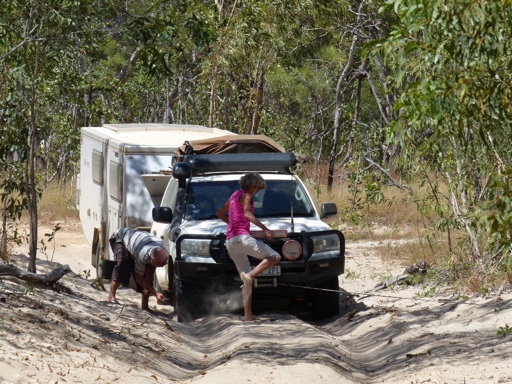
The first stretch of road was the normal corrogation. However between the two mine sites, one at Kowanyama and another some 30 - 50klms to the east the road "is shit" ( a description given to us by the jillaroo that we met well past this stretch). This stretch is deep sand with meandering tracks around the deep pits to try to find a better and safer route. Sometimes the "road" was al least 30m across.

Had we known, we would have been best to take the road from Gamboola to Drumduff and onto Koolatah before crossing the Mitchell River. But we didn't know! Wikicamps tell us there are several delightful places to stay along this road alongside the Mitchell River.

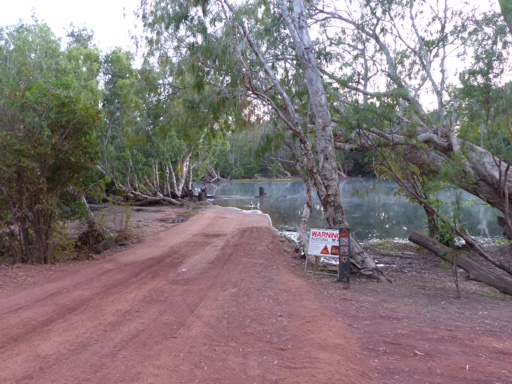
Just before we reached Dunbar Station, we took a right hand turn towards the Mitchell River and drove a further 18 klms to find a beautiful campsite just above the Mitchell River wet crossing. Here we stayed for two nights.

This is a very wide river with fast running fresh water. Each day the two local helicopter pilots and the jillaroo would bring themselves and their dogsfor a swim. Yes there are crocs here! They would drive their vehicle to the furtherest end of the causeway and park in the shallows. The dogs would be let off first and then they would roll about in the shallow lower end. Crocs love dog meat and will take a dog in preference to a human.

Just below from our camp they set freshwater prawn (cherabins) nets. They only caught three whilst we were there, but they are large and very tasty we are led to believe.

We did collect fresh water from the river for washing and washing up, so one of us was on "spot-the-croc" duty whilst the other fetched water. We did seea croc here, but it was only small and of the freshwater variety and therefore harmless.

The two pilots work for Dunbar Station and Rutland Plains Station, mustering during the season. It was interesting to find out that the homesteads are only really fully used for four months of the year. This is when the cattle are mustered, sorted and branded. The steers are taken on road trains to Cloncurry for fattening up, the bulls are de-sexed and then also sent to Cloncurry and the heifers set free again for breeding. A stud bull is left with the heifers. So basically the herd does not see a human for eight months. No wonder they are not domesticated like our herds. A caretaker manager maintains the generators and fridges etc during the wet months.

Dunbar Dtation is enourmous. It is 1.6 million areas. It took two hours of driving to go through it. It starts near Gamboola and goes as far as the Staaten River.
The jillaroo gave us some information about the road ahead, telling us that two cattle trains had recently become bogged in the sand. So we moved expecting to find the road as bad as before. We were pleasantly surprised to find that there were only two sand patches and not nearly as deep or as wide as previously.

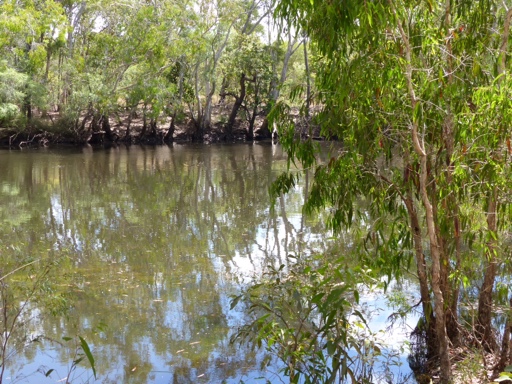
Our next camp was beside the Gilbert River. This river is not marked on the Hema maps. Again fresh water and running.

Here we saw at least 5 crocs, mostly we think they were fresh water.

By now the sandfly bites on my arms and legs had become an allergic action. So we were forced to go to Karumba, the only pharmacy from here to Atherton that could give me some antihistamines.

Normanton and Karumba are sandfly heaven, so we drove to the historic Croydon.

Mareeba and Chillagoe

After our stay at Cape Melville an overnight stop at Kalpower Crossing and another overnight stop at Mt Carbine Caravan Park, we were in urgent need of replenishing the food stores and to wash clothes. Mt in these cases as well as Mt Isa stand for Mining Town, not mountain as we normally think. Something we didn't know before staying this time with Neil and Deb!


Tawny Frogmouth at Mt Carbine. There was a family of three all sleeping together in the same tree.

After arriving within a communication area of Mareeba, we phoned Deb and Neil Lundstrum, who own a mango farm between Mt Malloy and Mt Carbine. We wanted to know if they would be home and could we stay on their farm.
So after re-stocking and clothes washing, we proceeded back up the road to their farm.

Neil and Deb are delightful. They live a very natural life, mostly outside and can turn their hand to anything.
Their daughter now lives on the property in this house.

This her bedroom.

Neil and Deb are now listed with Youcamp. They charge $2.50 per person, per night. They supply firewood and water. This is the camp kitchen and the loo with a view, or the blue loo!

That night Deb cooked a delicious Chinese meal for us all, Ginger Beef and Soy as well as Lemongrass Chicken with Cashews.

Next morning after preparing a picnic we set off in the car, fueled by old deepfryer oil from MacDonalds and fush and chip shops, to the dry side of the Mount Lewis National Park.

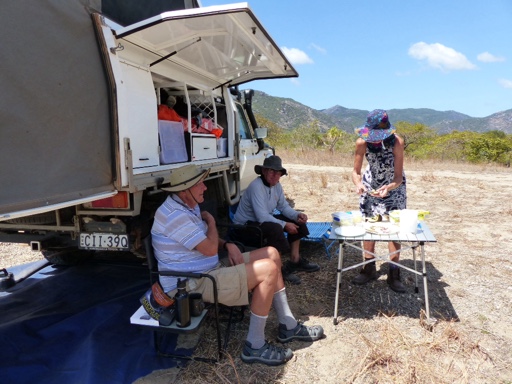
Here we found a lovely shady spot and brewed the billies for tea. We walked up and down the river as far as we could and returned for our picnic.


Deb and Neil wanted us to see Mary Falls. For this she had to seak special permission from the managers of the Brooklyn Australian Wildlfe Conservancy.

Along we bounced on a single strip track to find two beautiful falls in the middle af a very dry and parched area!

I cooked dinner that night on their outside fire pit. We had Dutch Roast Beef with baked potatoes and vegetables.

Peter and I reluctantly said farewell to Deb abd Neil the following morning. We knew that they had postponed their pruning of their mango trees in order to spend time with them and we didn't want to outstay our welcome.

So we drive to Chillagoe as we wanted to take the Alternative Savannah Highway to Normanton.

We stayed at the Chillagoe Ecolodge Caravan Park. An interesting place with a private observatory within the camp grounds. Great set up here with great ammenities and camp kitchen - almost deserted.

We went to the local hotel as well as roadhouse to try to fnd out somethng about the local road conditions to Normanton. Noone was able, or maybe reluctant to tell us anything! They simply told us that they didn't know!

Friday, August 24, 2018

Kalpower Crossing

Ray was really determined to go to Cape Melville. And having never been there before, we decided to go as well. We made a booking Kalpower Crossing for the night and several nights at Cape Melville. This was made possible by the self-serve booth at Lakeside Ranger Base.

The camsite is just beside the Normamby River, very tranquil and delightful with flushing toilets and cold water showers. You are allowed campfires as well!

Crocodiles are very active in the area and they live on either side of the wet water crossing at Kalpower.

Only 25 people are allowed into Cape Melville at a time. It is considered avery remote camping area and extensive recovery equipment is required.

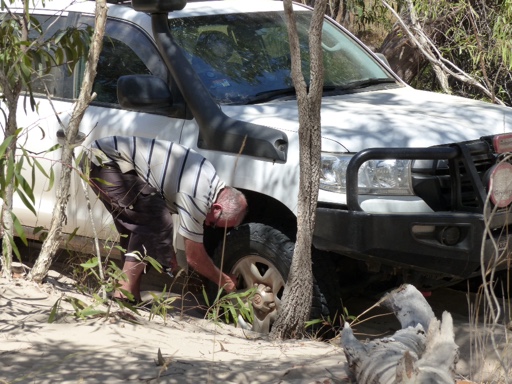
The road is very difficult in places and we had to dig the car out twice. Ray got soo bogged that he had to winch out several times! He kept blaming his car and not the weight of the camper pulling his car into the sand.

It took 4 hours of driving from Kakooka to our campsite, a distance of 43 klms! We eventually arrived at Crocodile Camp to find a pristine and magnificent beach with wonderful fishing.


It became very hot during the day, so we were forced to seek shelter wherever it was possible.

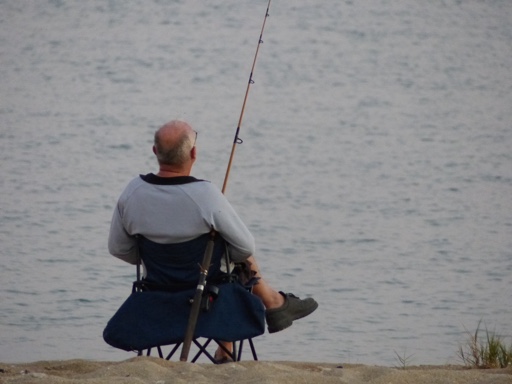
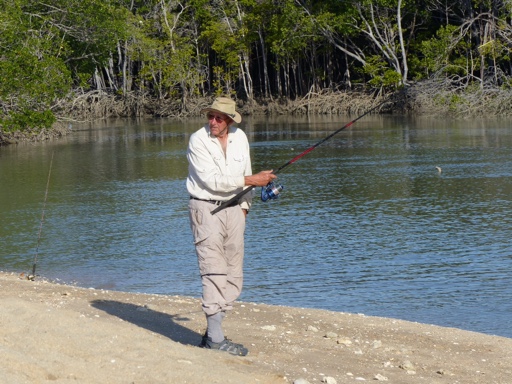
Fishing beside the billabong meant keeping an eagle eye out for the resident crocodile!

Leaving Cape Melville was cobsiderably easier than going we didn't need to wait for Ray and Annette and we knew the road a little better, so only had to dig ourselves out once. The return journey was 2 and 1/2 hours for the same distance.

Another overnight stop at Kalpower, where a billy of hot water was prepared for a much needed hot shower!!

Mauwbray River

After spending time at the shopping plaza near the dentist, we set off to fnd somewhere to stay the night.

No vacancies in most of the caravan parks until Mauwbray River Caravan Park, just off the highway 10 klms short of Port Douglas.

Very busy Big Four caravan park and almost full. At $42 per night for a non-powered site and with over 200 spaces, this caravan park was pulling in a small fortune.

Our first sand fly bites were received here!!

By this stage Ray and Annette were on their way to Archer River. This seemed doable from Mauwbray River.

So a market stop for fresh fruit and vegetables at Mossman and then a ferry crossing.....

Into the Daintree National Park, up the Bloomfield Track and onto Archer Point....

To find that they had already left and were at Elim Beach, just north of Cooktown; "Not far", they said!

Eventually we arrived to find Ray had bogged his rig in the sand!

Our exclusive beachside campsite was beautiful!

Ray had brought his pressure pack of permethryn which he sprayed around both our campsites.

Here we received our second lot of sand fly bites!